Key Takeaways
- Atheism generally refers to a lack of belief in any god or gods.
- Agnosticism concerns what humans can know, rather than what they believe.
- A person can identify as both an atheist and an agnostic because belief and knowledge are separate concepts.
- Agnostic theists believe in a higher power without claiming certainty, while agnostic atheists do not believe in gods but also do not claim absolute proof.
- These labels describe different aspects of a person's worldview and are not mutually exclusive.
Understanding Atheism and Agnosticism
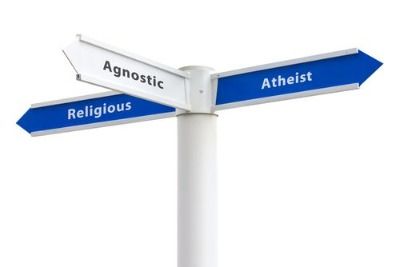
Even people who are not religious or don’t follow a traditional faith like to put labels on themselves. It’s human nature. “I’m vegan.” “I’m Hispanic.” “I’m a jogger/biker/swimmer/model.” People give themselves labels for everything, whether it’s necessary or not. Two labels people today often use interchangeably to describe what they believe or, rather, what they don’t believe are “atheism” and “agnosticism.” However, to use them interchangeably is incorrect. If you don’t follow traditional religion, or if you struggle to identify what you believe, consider the true meaning of each of these terms to decide if one — or both — is right for you.
What Is Atheism?
For starters, atheism is not necessarily a belief system; some claim its "followers" actively believe that there is no god while others argue it is simply a lack of belief in a god. In fact, etymologically speaking, the word means “not, or no god.” People within the atheism camp live with differing levels of certainty. Some will deny, with conviction, that any god exists, and provide evidence to support their claim. Others will say they do not believe that a god exists but will not claim to have any evidence of their assertion. Regardless of where a person falls in this camp, the common denominator is that they do not believe in the existence of any god.
What Is Agnosticism?
Agnosticism is not a belief system but rather a theory of knowledge. “Agnostic” means “not, or no knowledge.” An agnostic person does not claim to know whether or not a god exists, because he or she asserts that humans do not possess the resources, intellect, or capabilities to know anything beyond the physical realm and into the metaphysical. Therefore, agnostics also do not claim to understand the existence of angels, spirits, demons, gods, etc. A person who leans more toward agnosticism can further declare themselves as being either an agnostic theist or an agnostic atheist.
Agnostic Theist vs. Agnostic Atheist
Agnostic theism refers to the belief that there must be some god or higher being. However, agnostic theists do not claim to have “proof” that this is so. Agnostic atheism refers to the belief that a god or gods do not exist. However, like his or her theist counterpart, an agnostic atheist does not assert to have evidence to support this claim.
Essentially, agnostics, regardless of their stance on gods and higher powers, do not claim to know what is true and what is not. Agnostics base their assertions on logic and proven knowledge. They will tend not tell others they are right or wrong about their beliefs because they are convinced that no one (including themselves) can know for sure.
The term agnosticism was popularized when some people finally realized that individuals do not have to claim to have all the answers. It is not, despite popular belief, a term used to describe someone who has found some alternative between theism and atheism, or between the presence and absence of belief.
Atheism and Agnosticism Are Not Mutually Exclusive
Many people think they must be either atheist or agnostic if they don’t believe or claim to know, but that they cannot be both. This assumption implies that knowledge and belief are mutually exclusive, which they are not. In fact, they are very much compatible. Many people who rely on science and education often choose not to believe because of a lack of knowledge. On the other end of the spectrum are the people who need to believe because they don’t know, and the not-knowing is scary. A person can be an atheist, agnostic atheist, or even agnostic theist.
If you firmly believe that a god or gods do not exist, you’re an atheist. However, if you don’t know what to think because you don’t have enough “evidence,” chances are you’re an agnostic. Whatever label you assign to yourself, don’t let it limit your spiritual exploration or search for answers.
Explore Faith From Every Perspective
Questions about belief, doubt, and spirituality have inspired people for centuries. Whether you're religious, spiritual, agnostic, atheist, or simply curious, exploring different perspectives can lead to meaningful conversations and deeper understanding.
If your journey has inspired you to serve your community through weddings, memorials, baptisms, or other meaningful ceremonies, getting ordained with Universal Life Church is free and takes just minutes. You'll also gain access to guides, ceremony scripts, and resources to help you confidently officiate life's most important moments.
Frequently Asked Questions About Atheism and Agnosticism
Can someone be both an atheist and an agnostic?
Yes. A person can lack belief in a god (atheist) while also believing that the existence of a god cannot be known with certainty (agnostic). The two terms describe different concepts: belief and knowledge.
Is agnosticism a religion?
No. Agnosticism is a philosophical position about the limits of human knowledge. It does not prescribe beliefs, rituals, or a specific worldview.
Do all atheists claim that God does not exist?
Not necessarily. Some atheists actively believe no gods exist, while others simply do not hold a belief in any deity because they find the available evidence unconvincing.
What is an agnostic theist?
An agnostic theist believes in God or a higher power but does not claim to have definitive knowledge or proof that such a being exists.
What is an agnostic atheist?
An agnostic atheist does not believe in any gods while also maintaining that it is impossible, or currently impossible, to know with certainty whether any gods exist.
What is the main difference between atheism and agnosticism?
The primary difference is that atheism addresses belief—whether someone believes in a god—while agnosticism addresses knowledge—whether someone thinks it's possible to know if a god exists.
Do atheism and agnosticism oppose religion?
Not inherently. Atheism simply refers to a lack of belief in deities, while agnosticism expresses uncertainty about knowledge of the divine. Individuals who identify with either label may hold a wide range of views about religion, spirituality, and philosophy.