Key Takeaways
- Wedding readings are short passages from scripture, poetry, literature, or personal writing that help express a couple's values and love story.
- Most ceremonies include two or three brief readings, each lasting about one minute, to keep the ceremony meaningful and engaging.
- Wedding prayers can be religious, spiritual, or secular and should reflect the couple's beliefs and traditions.
- Family members and friends often deliver readings, making them a meaningful way to include loved ones in the ceremony.
- Officiants should work with the couple to choose readings and prayers that match the tone and purpose of their wedding ceremony.
Previous Step: Wedding Greeting
Every ceremony begins with a warm welcome. If you haven't already, learn how to deliver a confident wedding greeting that sets the tone for everything that follows.
How Wedding Readings and Prayers Make a Ceremony More Meaningful
Every couple wants a ceremony that feels deeply personal, but finding the exact words to capture their unique commitment is no easy task. That is where meaningful wedding readings and heartfelt wedding prayers come in. They ground the moment, giving voice to what the couple feels but might not know how to say out loud.
To help you structure a flawless service as a wedding officiant, this guide breaks down how to weave both wedding readings and prayers into the ceremony seamlessly, along with a curated collection of ready-to-use samples.
What Are Wedding Readings?
Wedding readings are passages from books, scriptures, poems, or other texts that are read aloud during the marriage ceremony. They usually come after the greeting and before the wedding charge and vows, though the couple can place them wherever they feel right.
The purpose of wedding readings and prayers is to set the mood of the ceremony and express the couple's idea of what love means to the people gathered.
Passages from Shakespeare, the Bible, and even classic children’s books are read at weddings. If a passage says something true about the couple's relationship, it belongs in the ceremony.
How Long Should a Wedding Reading Be?
Keep each wedding reading to roughly one paragraph, or about one minute of speaking time. A few short, heartfelt lines delivered with genuine emotion will always captivate a room far better than a lengthy passage included just to fill space.
Who Delivers the Wedding Reading?
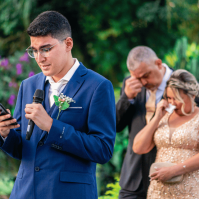
The officiant often reads the wedding ceremony readings, but readings are also a perfect way to include loved ones. A sibling, grandparent, or close friend who isn't in the wedding party can deliver a reading and feel like a true part of the day. Encourage any assigned readers to practice out loud beforehand so their nerves don't ruin the impact of the moment.
How To Choose Wedding Ceremony Readings
When you officiate a wedding, part of your job is guiding the couple toward readings that fit them. For example, a traditionally religious couple may want to read a scripture, while a secular couple may prefer poetry or prose.
Ask the couple if any specific books, authors, or Bible verses already matter to them, because the best wedding readings usually come from texts the couple already loves.
Common sources for readings include:
- Poetry, both classic and contemporary
- Scripture and other religious texts
- Novels and short stories
- Children's books with themes of love
- Letters, essays, or speeches about marriage
- Original pieces written by friends or family
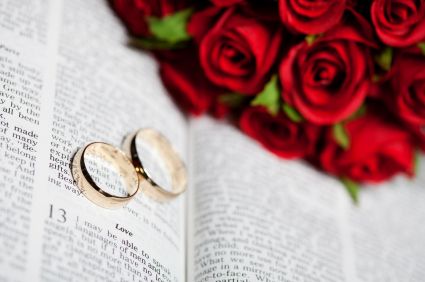
Once the couple picks their texts, help them trim each one to its strongest lines. Review the full wedding script with the couple and make sure everyone is on the same page about where the readings should be.
Sample Wedding Readings
The following sample wedding ceremony readings showcase the distinct style, tone, and themes that make a ceremony reading resonate. While the couple might choose entirely different texts for their big day, you can use these samples as a benchmark for the types of rhythmic, engaging passages that translate beautifully when spoken aloud.
Classic Poetry Wedding Reading
Shakespeare's Sonnet 116 remains one of the most popular wedding readings because it describes love as steady and unshakable.
Let me not to the marriage of true minds**
* *Admit impediments. Love is not love**
* *Which alters when it alteration finds,**
* *Or bends with the remover to remove.
O, no! It is an ever-fixed mark**
* *That looks on tempests and is never shaken;**
* *It is the star to every wandering barque,**
* *Whose worth’s unknown, although his height be taken.
Love’s not Time’s fool, though rosy lips and cheeks**
* *Within his bending sickle’s compass come;**
* *Love alters not with his brief hours and weeks,**
* *But bears it out even to the edge of doom.
If this be error and upon me proved,**
* *I never writ, nor no man ever loved.
William Shakespeare, Sonnet 116
Literary Wedding Reading
Don't overlook children's books. This beloved passage from “The Velveteen Rabbit” describes how real love takes time and leaves its marks.
"What is REAL?" asked the Rabbit one day, when they were lying side by side near the nursery fender, before Nana came to tidy the room. "Does it mean having things that buzz inside you and a stick-out handle?"
"Real isn't how you are made," said the Skin Horse. "It's a thing that happens to you. When a child loves you for a long, long time, not just to play with, but REALLY loves you, then you become Real."
"Does it hurt?" asked the Rabbit.
"Sometimes," said the Skin Horse, for he was always truthful. "When you are Real you don't mind being hurt."
"Does it happen all at once, like being wound up," he asked, "or bit by bit?"
"It doesn't happen all at once," said the Skin Horse. "You become. It takes a long time. That's why it doesn't happen often to people who break easily, or have sharp edges, or who have to be carefully kept. Generally, by the time you are Real, most of your hair has been loved off, and your eyes drop out and you get loose in the joints and very shabby. But these things don't matter at all, because once you are Real you can't be ugly, except to people who don't understand."
Margery Williams, “The Velveteen Rabbit”
Bible Readings for Weddings
The most popular Bible reading for weddings comes from 1 Corinthians 13:4–8, which describes what love does rather than what it feels like.
1 Corinthians 13:4–8
"Charity suffereth long, and is kind; charity envieth not; charity vaunteth not itself, is not puffed up, doth not behave itself unseemly, seeketh not her own, is not easily provoked, thinketh no evil; rejoiceth not in iniquity, but rejoiceth in the truth; beareth all things, believeth all things, hopeth all things, endureth all things. Charity never faileth."
Modern translations swap "charity" for "love," so ask the couple which version they prefer. Other favorite Bible verses include Ruth 1:16 and Ecclesiastes 4:9–12.
Ruth 1:16
“And Ruth said, Intreat me not to leave thee, or to return from following after thee: for whither thou goest, I will go; and where thou lodgest, I will lodge: thy people shall be my people, and thy God my God.”
Ecclesiastes 4:9–12
“Two are better than one; because they have a good reward for their labour.
For if they fall, the one will lift up his fellow: but woe to him that is alone when he falleth; for he hath not another to help him up.
Again, if two lie together, then they have heat: but how can one be warm alone?
And if one prevail against him, two shall withstand him; and a threefold cord is not quickly broken.”
What Are Wedding Prayers?
Wedding prayers invite a higher power into the ceremony and ask for blessings over the marriage ahead. Many Americans associate weddings with religion, so you'll likely consult with a couple about their favorite scripture or wedding ceremony prayers at some point in your officiant career.
Prayers can appear in several places. An opening invocation sets a sacred tone, a blessing before the vows asks for guidance over the promises, and a closing benediction sends the couple into married life with goodwill.
If the couple isn't religious or prefers to avoid religious language, replace the prayer with a secular or spiritual blessing, or omit it entirely. Your job is to make sure the ceremony reflects the couple’s beliefs and wishes.
Sample Wedding Prayers and Blessings
Because prayer is shaped by faith, the wording of wedding prayers and blessings will change dramatically from one tradition to another. The samples below cover several backgrounds you may encounter as a minister. Use them directly or as inspiration.
Christian Wedding Prayers
Christian wedding prayers typically thank God for the couple's love and ask for protection over their marriage. Here are three you can adapt.
- “Our Father, Love has been Your richest and greatest gift to the world. Love that matures into marriage is one of Your greatest creations. Today we celebrate this kind of love as it manifests itself with [Name] and [Name]. Please protect, guide, and bless [Name] and [Name] as they enter into their shared lives. For today and for the rest of their lives, let them love each other as You love them. Amen.”
- “Lord of Heaven and Earth, [Name] and [Name], their gathered friends and family, and I pray that You grant this loving couple never-ending understanding, patience, tolerance, and affection as they begin to live life together. We pray that [Name] and [Name] will always love and respect each other, and that their home be eternally filled with happiness, joy, and laughter. We ask this in the name of Jesus Christ. Amen.”
- “Loving God, we thank You for the joy and happiness that mark this occasion. We thank You for the tender love that [Name] and [Name] share. We thank You for the many people who have gathered here today to witness their love and to celebrate their marriage. And, most importantly, we thank You for Your presence at this service now and Your continued presence in the married life of [Name] and [Name] for the rest of their shared lives. Amen.”
 Hindu Wedding Prayer
Hindu ceremonies often include prayers about unity and shared purpose. The following is a standard wedding prayer at Hindu and other South Asian weddings.
“May our prayers be the same, may our goals be the same. Common be our purposes, our deliberations harmonious. May our desires be one, and our hearts be one. May our intentions have oneness, and blissful be our togetherness.”
Sikh Wedding Prayer
Sikh wedding ceremonies traditionally include sacred hymns from the Guru Granth Sahib. The following passage asks for divine guidance and protection as the couple begins their life together.
“Whatever work you wish to accomplish, tell it to the Lord. Your affairs will be resolved; the True Guru gives his guarantee of truth. In the society of saints, you shall taste the treasure of the ambrosial nectar. The Lord, who is the merciful destroyer of fear, preserves and protects those who serve him. O Nanak, singing the glorious praises of God, one sees the unseen Lord.”
Pagan Wedding Blessing
Pagan ceremonies connect the couple's love to nature and the elements. This wedding blessing and others like it are generally read during pagan weddings.
“Above you are the stars, below you are the stones. As time passes, remember: Like a star should your love be constant. Like the earth should your love be firm. Possess one another, yet be understanding. Have patience with each other, for storms will come, and they will go quickly. Be free in giving of affection and of warmth. Have no fear, and let not the ways or words of the Unenlightened give you unease. For the old gods are with you, now and always!”
Nondenominational Spiritual Wedding Blessing
Some couples want their wedding ceremony to acknowledge a sense of wonder, connection, or higher purpose without referring to a particular religion. This wedding blessing honors the spiritual connection surrounding the couple’s marriage without referring to a particular religion.
“May the loving energy that moves through all of life surround [Name] and [Name] as they begin this marriage. May they remain open to the mystery that brought their paths together and mindful of the sacred bond they now share. May their love be a source of strength in difficult seasons, a light in uncertain moments, and a place of peace for both of them. May they grow together in wisdom, compassion, and spirit, and may the life they create reflect the deepest intentions of their hearts.”
Next Step: Special Wedding Rituals
After the readings, many couples include special wedding rituals such as a unity candle, handfasting, or sand ceremony. Learn when these rituals take place and how to officiate them.
Help Couples Create Meaningful Wedding Ceremonies
Choosing the perfect wedding readings and prayers is just one part of creating an unforgettable ceremony. As an ordained minister with Universal Life Church, you'll gain access to wedding ceremony scripts, officiant training, legal guidance, and a supportive community of ministers to help you confidently perform weddings of every style and tradition.
Ordination is free, takes only a few minutes online, and allows you to perform weddings in most parts of the United States. Become ordained today and start helping couples celebrate one of life's most meaningful moments.
Frequently Asked Questions About Wedding Readings and Prayers
What is the difference between a wedding reading and a wedding prayer?
A wedding reading is a passage from scripture, poetry, literature, or another meaningful source that reflects the couple's beliefs or relationship. A wedding prayer asks for blessings, guidance, or well wishes for the marriage and may be religious, spiritual, or secular.
Where do wedding readings and prayers go during the ceremony?
Wedding readings usually take place after the welcome and before the vows, although couples can place them wherever they prefer. Prayers are commonly used as an opening invocation, a blessing before the vows, or a closing benediction.
Who should read the wedding readings?
The officiant can read the selected passages, but many couples invite parents, siblings, grandparents, or close friends to participate. Choosing loved ones to deliver readings helps create a more personal and memorable ceremony.
Can a wedding ceremony include both religious and nonreligious readings?
Yes. Many modern ceremonies combine scripture with poetry, literature, or personal writings. Interfaith and multicultural weddings often include readings from multiple traditions alongside secular selections that reflect the couple's shared values.
How do you choose the best wedding readings?
The best wedding readings reflect the couple's personality, beliefs, and relationship. Officiants should encourage couples to select passages that already have personal meaning rather than choosing popular readings simply because they're traditional.
Can wedding prayers be personalized?
Absolutely. Many officiants write custom prayers or blessings that include the couple's names, values, and hopes for their future together. Personalized prayers often feel more meaningful than using a standard template.