Key Takeaways
- A divination pendulum is a weighted object on a chain or cord that swings in response to questions you ask.
- Pendulum divination is most useful for yes-or-no questions, energy work, meditation, and spiritual reflection.
- Before asking your questions, always establish your answer key by asking the pendulum to show you what "yes," "no," and "unclear" look like.
- A pendulum reading is a guide for reflection, not a replacement for professional advice or personal responsibility.
What if a small weight on a string could help you pause, ask better questions, and actually listen for answers? That's the idea behind pendulum divination. People have used weighted objects on cords for spiritual guidance and intuitive reflection for centuries. Today, the practice is used across many belief systems as a grounded, accessible way to slow down and connect with your intuition.
Whether you're completely new to spiritual tools or just curious about how to use a divination pendulum, this guide walks you through everything from setup to closing the reading.
What Is a Divination Pendulum?
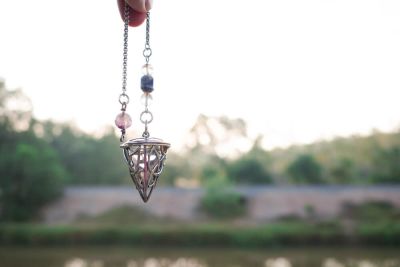
A divination pendulum is a small weighted object that hangs freely from a chain, cord, or string. When you hold the top still and ask a question, the pendulum swings in response, and those movements are interpreted as answers.
Pendulums are commonly made from crystal, metal, or wood, but the material doesn't have to be special or expensive. A ring, a charm, or any small weighted object on a cord works just as well. What matters is that it hangs freely and feels comfortable to hold.
What Is the Practice of Pendulum Divination?
Pendulum divination is an ancient spiritual practice with roots going back thousands of years. Early forms appear in Chinese, Egyptian, and Roman history, where suspended weighted objects were used to seek guidance, detect energy, and answer questions. You might also hear it called “pendulum reading” or “radiesthesia,” which is the formal term used in scientific and parapsychological research.
Today, pendulum divination shows up across many traditions, from folk magic and Wiccan practice to New Age spirituality and energy healing. This alternative ritual is one of the more accessible entry points into spiritual tools because it requires very little setup and no prior experience.
What Is a Pendulum Reading?
A pendulum reading is a structured session in which you use a divination pendulum to seek guidance, reflect on a question, or tune into your intuition. Each reading has a clear beginning, middle, and end.
Before each reading, you establish what each movement means. For example, a forward-and-back swing might mean "yes," a side-to-side swing might mean "no," and a circular motion might mean "unclear." The exact system is yours to define at the start of every session.
A reading can be a private solo practice or something you lead for a small group. Sessions can be as short as a few minutes, and shorter readings are often clearer for beginners.
How Do You Use a Divination Pendulum?
You don’t need to be an expert to lead a meaningful pendulum reading. Follow these steps to move through a reading from start to finish.
Step 1: Ground Yourself
Sit comfortably with both feet on the floor. Take a few slow breaths and let your body settle. You can open with a short prayer or blessing: "May this reading bring clarity, wisdom, and peace."
If you're leading a group, give everyone a quiet moment before moving forward.
Step 2: Hold the Divination Pendulum Steady
Hold the chain between your thumb and forefinger and let the pendulum hang freely. Resting your elbow on a table can help you stay steady. Don't try to force the pendulum to move. Give it a moment to settle. This is especially important if you feel anxious or rushed.
Step 3: Establish Your Answer Key
Before asking any real questions, ask the pendulum to show you what each response looks like. Say, "Show me yes," and watch the direction of the swing. Then say, "Show me no," and note the difference.
You can also ask it to show you "maybe" or "unclear." This step creates the key you'll use to interpret answers throughout the reading.
Step 4: Test With a Known Question
Ask a simple question you already know the answer to, such as "Is my name [your name]?" or "Am I sitting down?" This confirms the answer key is working and helps you settle into the rhythm of the reading before moving into more meaningful questions.
Step 5: Ask Your Main Question
Now ask what you actually came here to explore. Pendulums work best with yes-or-no questions.
Instead of asking "What should I do with my life?", try something more focused: "Is this choice aligned with what I need right now?" Give the pendulum time to respond and watch without trying to influence the outcome.
Step 6: Reflect Before Moving On
After the pendulum answers, pause. Notice how the response feels. Does it bring clarity, resistance, or confusion?
Journaling between questions can help you track what comes up. Pendulum readings are most useful when they lead somewhere thoughtful, not when you ask the same question 10 times, hoping for a different answer.
Step 7: Close the Pendulum Reading
When you’re finished, close the session formally. You might say: "This reading is complete. Thank you for the guidance received."
Then set the pendulum down on a cloth or near a meaningful object. Skipping this step can make the ritual feel unfinished, so a clear closing helps mark the end of the reading.
What Are Good Questions To Ask a Pendulum?
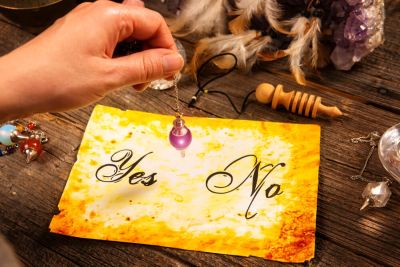
When using a pendulum, the clearer your question, the more useful the answer. You want questions that are honest, specific, and focused on your own choices and awareness.
Good examples of questions to ask a divination pendulum include:
- Is this the right time to move forward with [decision]?
- Would [change or choice] support my peace and well-being?
- Am I approaching [situation] with honesty?
- Is there something I need to pay more attention to in [area of life]?
- Would stepping back from [situation] serve me better than moving forward?
- Is [relationship or opportunity] aligned with my values?
- Do I need more time before I act on [decision]?
Questions to avoid include anything vague, fear-based, or centered on controlling another person. Asking "Does this person secretly love me?" or "Should I ignore professional advice?" is not a good use of the tool.
Using a Pendulum Ethically
If you use a pendulum with others, consent matters more than almost anything else. Just as you wouldn't cast a spell on someone without their knowledge, conducting a pendulum reading without consent crosses a similar line. Always ask before reading for someone else, and be clear that a reading is spiritual guidance, not a guaranteed prediction.
If someone is in a genuine crisis, a pendulum reading is not the right thing to do. Guide them toward a mental health professional, a crisis line, or another qualified source of real help. Ethical pendulum use respects both the person in front of you and the limits of what this practice is actually meant to do.
Can a Pendulum Predict the Future?
Some people believe a pendulum can reveal likely outcomes based on current energy or spiritual guidance. Others see it purely as a tool for intuition and self-reflection, with no predictive power at all.
What most experienced practitioners agree on is that treating a pendulum as a guaranteed prediction tool is a mistake. The future shifts based on your choices, timing, other people, and circumstances outside your control. A pendulum reading captures a moment, not a fixed outcome.
What Mistakes Do Pendulum Divination Beginners Make?
Starting with a pendulum is simple, but a few common habits can undermine the practice.
Asking the Same Question Repeatedly
If you ask the same question over and over, expecting that the answer may change, you're no longer seeking guidance. You are looking for confirmation. Ask your question once, sit with the answer, and journal about what comes up before revisiting it.
Using the Pendulum While Anxious or Emotional
An overwhelmed mind makes it harder to stay steady, both physically and emotionally. If you're in the middle of a crisis or highly charged moment, wait. Come back when you feel calmer. The pendulum reading will be more useful for it.
Asking Vague or Unfocused Questions
A pendulum reading is only as clear as the question you ask. A question like "Will everything be OK?" is too broad to produce anything meaningful. The more specific and honest your question, the clearer the response tends to be.
Treating Every Answer as Absolute Truth
A pendulum reading is a tool for reflection, not a final verdict. If an answer surprises or unsettles you, that reaction is worth exploring. It doesn't mean you must act on it or that the outcome is set in stone.
Reading for Others Without Permission
Always get consent before reading for someone else. Conducting a reading about another person without their knowledge raises real ethical concerns, regardless of your intentions.
Depending on the Pendulum for Every Decision
Pendulum divination works best as one part of a broader reflective practice, not as a decision-making machine. If you find yourself unable to make any choice without consulting the pendulum first, that’s a sign to step back and reconnect with your own judgment.
Continue Your Spiritual Journey

Pendulum divination is just one of many ways people explore spirituality, mindfulness, and personal growth. Whether you're interested in rituals, meditation, energy work, or other spiritual practices, every journey begins with a willingness to learn and remain open to new perspectives.
If you're ready to take the next step in your spiritual journey, consider becoming an ordained minister through the Universal Life Church. Ordination is free, takes just minutes online, and connects you with a global community of spiritually minded individuals. You'll also receive access to newsletters, guides, and educational resources that can help you deepen your practice, explore new perspectives, and continue learning along the way.
Join millions of people who have taken the next step in their spiritual journey by getting ordained today.
Frequently Asked Questions About Pendulum Divination
Can anyone use a divination pendulum?
Yes. Pendulum divination does not require special training or psychic abilities. Many people use it as a tool for reflection, meditation, and spiritual practice.
What does it mean when a pendulum moves in a circle?
The meaning depends on the answer key you establish at the beginning of the reading. Many practitioners use circular movements to indicate "unclear," "maybe," or a need for more information.
Do pendulums have to be made of crystals?
No. Crystal pendulums are popular, but any weighted object suspended from a chain or cord can function as a pendulum.
How often should you use a pendulum?
There is no strict rule. Many people use pendulums as needed for reflection or spiritual guidance, while avoiding repeated questions that can lead to confirmation-seeking.
Can you use a pendulum for someone else?
Only with their knowledge and consent. Ethical pendulum practice respects personal boundaries and avoids reading for others without permission.