Key Takeaways
- Voodoo is a religion with organized beliefs, rituals, and spiritual leaders, while Hoodoo is a system of folk magic rather than a religion.
- Voodoo originated in West Africa and developed further in places such as Haiti and Louisiana.
- Hoodoo developed primarily within African American communities in the Southern United States.
- Although both traditions share African influences, they have distinct histories, practices, and purposes.
- Understanding the differences between Voodoo and Hoodoo helps avoid common misconceptions and cultural stereotypes.
Understanding the Difference Between Voodoo and Hoodoo
If you are interested in magic, witchcraft, or faith healing, you’re probably familiar with the practices of Voodoo and Hoodoo. But are you aware that even though Voodoo and Hoodoo share similar names and have practices that look the same, these two belief systems are completely different from each other?
The most important difference between them is that Voodoo is an actual religion, while Hoodoo is not.
Voodoo has its own rituals, leaders, teachers, representatives, and services, plus two distinct branches: the Vodou of New Orleans and Louisiana, and the Vodue of Haiti.
Hoodoo, on the other hand, is not a religion. It has no organizational structure, and is practiced by individuals – sometimes called root doctors or root healers – who claim to have certain magical powers.
Where Did Voodoo and Hoodoo Originate?
Voodoo (also spelled Vodou or Vodun) originated from the traditional African religions of the Fon and Ewe people in what is now Benin and Ghana. Enslaved Africans brought Voodoo to the Americas, especially to Haiti, where it evolved and mixed with other religious traditions, like Catholicism, into what is known as Haitian Vodou.
Hoodoo, on the other hand, has its origins in the United States – primarily among African American communities in the Southern U.S. Its roots stem from a combination of West African folk traditions, Native American practices, and European folklore and magick practices. It's not a religion, but rather a set of magical practices.
Voodoo Beliefs and Practices
Voodoo followers believe in an omnipotent and unknowable Supreme Creator named Bondye. His name comes from the French term Bon Dieu, literally meaning “good God.” Generally, a Haitian Voodoo service will be conducted in Creole, a Haitian French dialect.
Per Voodoo belief, Bondye does not directly intercede in the lives of human beings. Consequently, Voodoo priests and priestesses call upon the Loa, spirits who work for Bondye. Different Loa are responsible for various aspects of human life.
Three of Voodoo’s most important families of spirits are those belonging to Rada, Petro, and Gede. Rada spirits are benevolent; Petro spirits are angry, violent, or evil; and Gede spirits are those who deal with death and dead people.
Many Gede spirits are zombies, in the original sense of that word. But they don’t eat the brains of the living or otherwise violently attack them, like in the movies. In Voodoo, a zombie is a victim, not a monster. He or she is a walking dead person who must give obedience to the person who raised him or her from the dead.
Many people believe that the idea of zombies came into Haitian Voodoo culture as a means of expressing the deadness of being a slave. In other words, the concept of zombies, and Voodoo itself, arose as a spiritual force among slaves to help them endure their suffering.
Hoodoo Beliefs and Practices
Hoodoo is a form of hybrid African folk magic that often emphasizes the practical uses of magic for purposes such as healing, protection, and divination.
Although not a formal religion, Hoodoo does blend in faith beliefs from different religions into its traditions. For example, practitioners often call upon Roman Catholic saints, biblical characters such as Moses, or even Native American spirits to aid them in casting their spells.
Some Hoodoo practitioners consider themselves Catholics who believe in both Catholic saints and African gods.
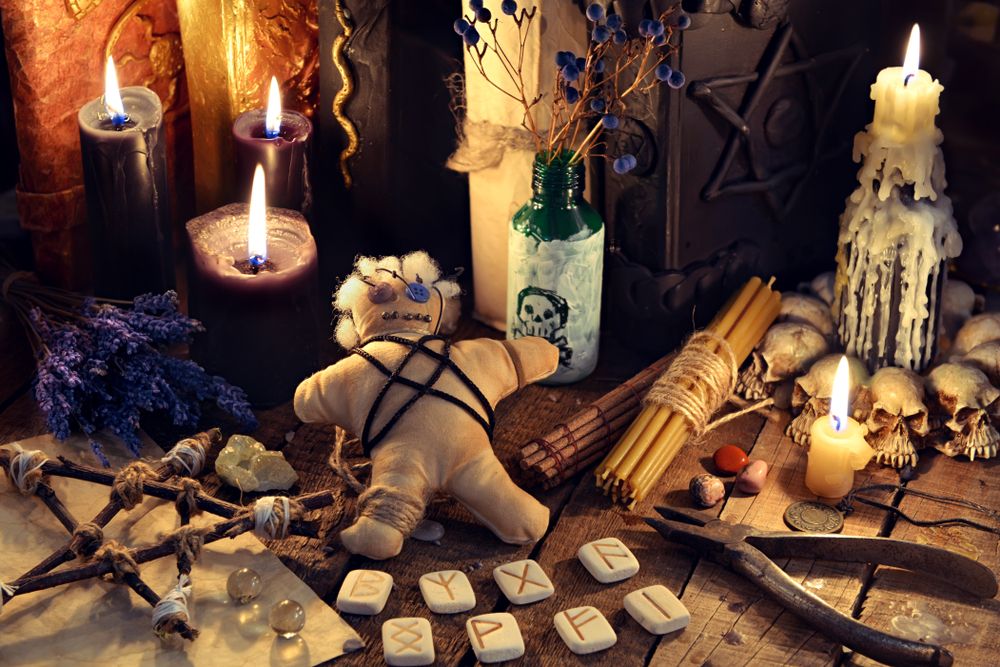
In the United States, Hoodoo sessions are conducted in English and Hoodoo practitioners spell their magic "magick." The practitioner will use such materials as roots, herbs, crystals, and animal parts for ritual purposes. In some cases, they will even utilize bodily fluid (such as tears, saliva, urine, etc.), belonging to the person for whom the session is being conducted.
Those leading Hoodoo rituals may also reference religious texts, like the Bible, but not for the purposes of conducting the session in the name of Jesus. Rather, they call upon the saints or others to help guide the use of the roots and other talismans that are part of the ceremony.
Since Hoodoo is not a religion, it has no written documents to study from or formal process to become a member. Instead, practitioners pass on their spiritual powers to their own descendants.
Why Are Voodoo and Hoodoo Differences Important?
While the words "Voodoo" and "Hoodoo" are sometimes used interchangeably due to misunderstandings or misinformation, they refer to distinctly different traditions with different origins and practices.
Many people of both persuasions believe that Voodoo was the original religion, with Hoodoo becoming a denomination in much the same way as the Methodists, Unitarians, Baptists, et al., became denominations of Protestant Christianity.
Why is that distinction important?
Conflating these traditions can lead to ignorance and stereotyping, which can be offensive to the practitioners and the cultures they originate from. Accurate representation fosters respect and understanding of diverse cultural practices and beliefs.
Although popular culture tends to paint Voodoo and Hoodoo as mere superstitions, it's crucial to recognize that not only are these very real beliefs, but also that a rather large swath of people adamantly adhere to them.
Learn About the World's Diverse Spiritual Traditions
Exploring different religions and spiritual practices helps foster understanding, respect, and meaningful dialogue across cultures. Whether you're studying world religions or simply expanding your perspective, learning about traditions like Voodoo and Hoodoo is an important step toward greater religious literacy.
If you're inspired to serve your own community, getting ordained with Universal Life Church is free and takes only a few minutes. You'll gain access to resources, ministry guides, and a supportive community to help you confidently officiate weddings, lead ceremonies, and support others through life's important moments.
Frequently Asked Questions About Voodoo and Hoodoo
Is Voodoo the same as Hoodoo?
No. Although the names are similar and both traditions have African influences, Voodoo is an organized religion, while Hoodoo is a system of folk magic and spiritual practices rather than a religion.
Is Voodoo a recognized religion?
Yes. Voodoo (also known as Vodou or Vodun, depending on the tradition) is a recognized religion with its own beliefs, ceremonies, clergy, and spiritual practices. It is especially practiced in Haiti, Benin, and parts of the United States, including Louisiana.
What is Hoodoo used for?
Hoodoo is generally practiced for practical purposes such as protection, healing, luck, cleansing, and spiritual guidance. Practices vary widely among individual practitioners and communities.
Do Voodoo and Hoodoo have the same origins?
They share influences from West African spiritual traditions, but they developed differently. Voodoo evolved as a religion through the blending of African beliefs with other religious traditions, while Hoodoo developed in the American South as a form of African American folk magic incorporating multiple cultural influences.
Do all Voodoo practitioners believe in zombies?
No. Popular culture has greatly exaggerated and fictionalized the concept of zombies. Traditional Voodoo beliefs surrounding zombies differ significantly from the monsters portrayed in movies and television.
Can someone practice Hoodoo without following a specific religion?
Yes. Because Hoodoo is not a religion, practitioners may identify with various faiths—or none at all. Some incorporate Christian prayers, biblical passages, or other religious elements into their personal practices.
Why is it important to distinguish between Voodoo and Hoodoo?
Using the terms interchangeably can reinforce stereotypes and overlook each tradition's unique history and cultural significance. Understanding their differences encourages greater respect for the communities that practice them.