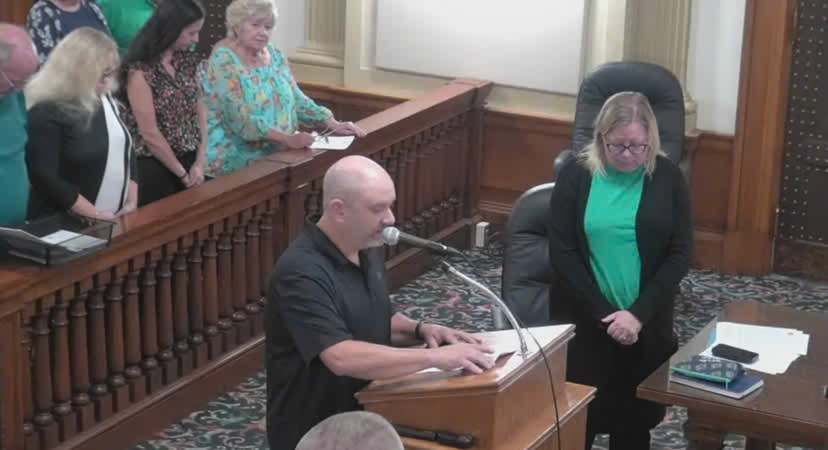
A city council meeting in Ottumwa, Iowa, sparked controversy on October 6, 2026, when a former council member delivered a Satanic invocation ending with the words “Hail Satan.” The prayer prompted an immediate objection from a local pastor and renewed debate over religious freedom, government prayer, and the separation of church and state.
Key Takeaways
Former Ottumwa City Council member Matt Dalbey, a member of The Satanic Temple of Iowa, delivered the invocation.
The city's invocation policy allows residents of different religions, belief systems, and nonreligious perspectives to participate.
The Satanic Temple does not worship a literal Satan, instead emphasizing reason, individual liberty, and secular values.
The controversy raises questions about religious neutrality and the First Amendment.
Why Did an Iowa City Council Allow a Satanic Prayer?
According to the Ottumwa Courier, the invocation was delivered by Matt Dalbey, an Ottumwa resident and former city council member who belongs to The Satanic Temple of Iowa.
The prayer was permitted under an invocation policy adopted by the Ottumwa City Council in January 2026. Approved by a 4-1 vote, the policy allows residents to volunteer to deliver opening invocations regardless of their religious affiliation or beliefs.
The city's official invocation policy is intended to respect the diversity of religious and philosophical perspectives within the community without endorsing any particular faith.
That includes religious minorities, nontraditional belief systems, and people who do not identify with an organized religion.
Councilwoman Cara Galloway, who cast the only vote against the policy, had previously warned that allowing public invocations could invite controversy.
What Did the Satanic Invocation Say?
Dalbey began his invocation by addressing a “Dark Father” before encouraging listeners to question established doctrines and embrace knowledge.
He called upon those present to embrace the “Luciferian impulse” to eat from the tree of knowledge, emphasizing intellectual inquiry and the rejection of unquestioned beliefs.
The invocation concluded with the words “Hail Satan.”
Although the language sounded like devil worship to some attendees, Dalbey explained that The Satanic Temple of Iowa is a nontheistic organization.
Unlike some forms of theistic Satanism, The Satanic Temple generally treats Satan as a literary symbol of rebellion against arbitrary authority rather than a supernatural being.
Its philosophy emphasizes reason, personal autonomy, compassion, and religious liberty.
Pastor Calls Satanic Prayer a Curse on the City
The invocation prompted an immediate objection from Rick Bick, a pastor at New Life Center.
Following the prayer and Pledge of Allegiance, Bick approached the podium and called for the invocation to be reversed, describing it as a curse upon Ottumwa.
Councilwoman Cara Galloway objected to Bick speaking outside the designated public comment period.
Mayor Benjamin Foote subsequently called for a 30-second moment of silence, allowing those present to reflect before the council resumed its business.
The controversy soon spread beyond Ottumwa. City officials reported receiving numerous phone calls, while footage of the invocation circulated online.
Despite the backlash, City Administrator Phil Rath defended the city's obligation to apply its invocation policy without discriminating against religious beliefs.
Does the First Amendment Protect Satanic Prayers at Government Meetings?
The controversy raises an important constitutional question: Can a city permit Christian prayers at government meetings while excluding Satanic invocations?
Generally, government bodies that allow religious invocations cannot exclude speakers simply because officials or members of the public disagree with their religious viewpoints.
The Supreme Court addressed legislative prayer in Town of Greece v. Galloway (2014), ruling that opening prayers at local government meetings can be constitutional under certain circumstances.
However, government prayer practices must not be administered in ways that unlawfully discriminate against particular faiths.
Ottumwa's policy expressly welcomes different religious and philosophical perspectives. Excluding a Satanic invocation solely because its message is unpopular could therefore raise serious constitutional concerns.
This principle also protects minority religions and people who practice ministry without believing in God.
Could Ottumwa Ban Satanic Invocations?
Ottumwa is not necessarily required to continue its current invocation policy indefinitely.
The city could consider eliminating opening invocations altogether or replacing them with a secular moment of silence. It could also review its existing rules, provided any changes comply with constitutional protections.
What officials cannot safely do is maintain a religious invocation program while selectively excluding viewpoints simply because they are controversial or offensive.
The incident illustrates a broader tension in American public life. Religious freedom protects familiar traditions, but it also extends to beliefs that many people may find uncomfortable or objectionable.
For Ottumwa, the central question is no longer simply whether a Satanic prayer belongs at a city council meeting. It is whether a government that welcomes religious expression is prepared to apply that principle equally.